
How to Choose a Shockwave Therapy Clinic in Auckland: 7 Things to Check Before You Book

If you’re researching shockwave therapy in Auckland, you’ve probably noticed that many clinics offer it, physios, osteopaths, podiatrists and sports medicine practices across the city.
What most people don’t realise until after they’ve paid for a course of treatment is that shockwave therapy varies enormously between clinics. The device used, the type of shockwave available, the practitioner’s training, and whether treatment sits inside a proper rehabilitation plan all directly affect your results.
Shockwave therapy is dose-dependent: research outcomes achieved in clinical trials only apply if your treatment delivers comparable energy to the tissue. Two clinics can both advertise “shockwave therapy” and deliver very different treatments.
Here’s what to check before you book, anywhere.
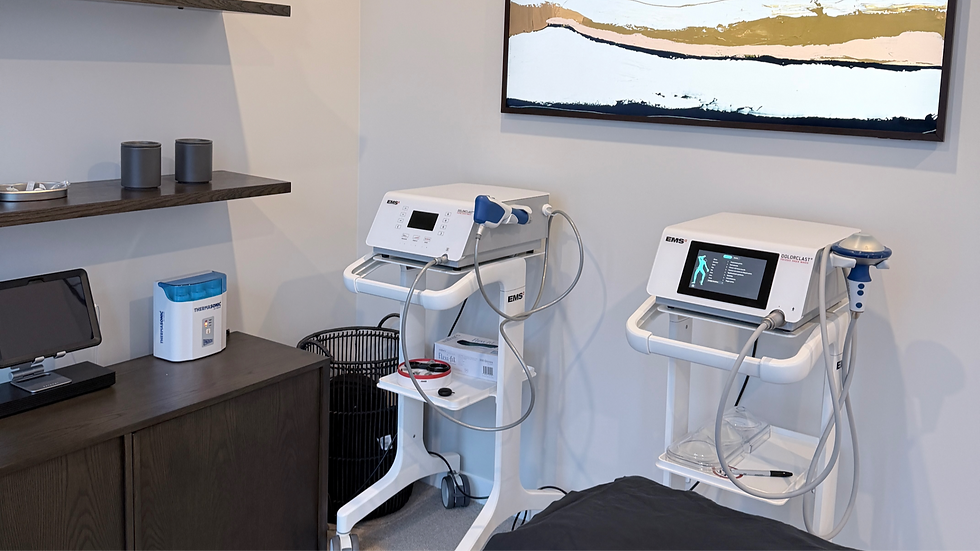
1. Ask which device the clinic uses (this matters more than anything)
Shockwave research is built on specific devices at specific settings. The device your clinic uses determines whether your treatment matches the evidence. Ask two questions:
“Which shockwave device do you use?” The EMS Swiss DolorClast® is the most studied shockwave system in the world, used in more high-quality studies on the PEDro physiotherapy evidence database than any other ESWT device. If a clinic can’t or won’t name their device, that’s your answer.
“Can it sustain energy output at higher frequencies?” This is the technical detail most clinics hope you won’t ask about. Independent bench testing published in Scientific Reports (Reinhardt et al., 2022) found significant differences in energy output between radial shockwave devices at higher frequency settings, the EMS DolorClast® maintained substantially higher energy density than competing systems, including the Storz MASTERPULS® 200 ultra, at frequencies of 15 Hz and above. Lower delivered energy means a weaker biological stimulus, which can mean more sessions, slower progress, or no result at all.
At Movement Mechanics: we use EMS DolorClast® devices exclusively, and our founder is New Zealand’s EMS DolorClast® Key Opinion Leader.

2. Check whether they offer radial, focused, or both
Most Auckland clinics offer radial shockwave only. Radial waves disperse energy across broader, superficial tissue, well suited to conditions like plantar fasciitis, tennis elbow and mid-portion Achilles tendinopathy. But some conditions involve structures that radial energy simply cannot reach effectively:
Deep hip and gluteal tendon problems
Bone-level presentations (e.g. delayed-union stress injuries)
Deeper calcific shoulder deposits
Dupuytren’s contracture nodules
Structures beneath significant soft-tissue depth
These need focused shockwave therapy, which concentrates acoustic energy at a precise, adjustable depth. A radial-only clinic can only offer you radial shockwave, whether or not it’s the right tool for your condition. A clinic with both can match the technology to your presentation instead of the other way round.
At Movement Mechanics: we are currently the only clinic in New Zealand with the EMS DolorClast® Focused Shockwave device, alongside EMS radial shockwave and high-power laser therapy.

3. Insist on a diagnosis before treatment starts
Shockwave therapy is highly effective for the right conditions, plantar fasciitis, Achilles tendinopathy, tennis elbow, calcific shoulder tendinopathy, patellar tendinopathy and greater trochanteric pain syndrome all have strong evidence. But heel pain isn’t always plantar fasciitis. Shoulder pain isn’t always a rotator cuff tendinopathy. Applying shockwave to the wrong diagnosis wastes your money and delays proper treatment. A quality clinic will:
Take a full history and perform hands-on orthopaedic assessment first
Refer for imaging (ultrasound, X-ray) when the diagnosis is unclear
Tell you if shockwave is not appropriate for your condition, and offer an alternative
Screen contraindications: pregnancy, blood-thinning medication, recent cortisone injection, clotting disorders
4. Ask what happens alongside the shockwave
Shockwave is a stimulus, not a cure. It creates a biological environment in which tendon tissue can heal, but long-term results depend on what happens next: progressive loading, addressing the biomechanics that overloaded the tissue in the first place, and a structured return to activity. Questions worth asking:
Do you prescribe rehabilitation and loading programmes alongside shockwave?
Do you assess why the tendon became overloaded (movement analysis, strength, training load)?
What happens after the shockwave course finishes?
A machine-only service, turn up, get zapped, leave, reliably underperforms integrated care. This is consistent across the tendinopathy literature: shockwave plus loading outperforms either alone.
At Movement Mechanics: shockwave is integrated with osteopathy, high-power laser therapy, electro-acupuncture, and progressive rehabilitation, one clinical team, one plan.

5. Look for transparent pricing, and a defined endpoint
You should know exactly what a course of treatment will cost before you start. Ask:
What does each session cost? (Auckland range is typically $120–$190 per session)
How many sessions will I likely need? (Most evidence-based protocols: 3–6 sessions)
When do we review whether it’s working?
Good clinics treat to a plan with a defined review point, improvement by session three is one of the strongest predictors of full recovery. Be wary of open-ended treatment with no review milestones.
At Movement Mechanics: pricing is published, shockwave from $130 single site, $200 multi-site, and combined laser + shockwave from $150. Most patients see meaningful improvement within 4–6 sessions, and we tell you at the outset if you’re unlikely to benefit.
6. Check practitioner training and reviews
Shockwave outcomes are operator-dependent: correct localisation of the target tissue, appropriate energy dosing, and clinical judgement about progression all come from training and volume of cases. Worth checking:
Is the practitioner a registered health professional (osteopath, physiotherapist, podiatrist)?
Have they completed device-specific certification (e.g. GDT certification for EMS devices)?
How many shockwave cases do they treat, and for which conditions?
What do Google reviews say, specifically about shockwave results, not just friendly service?

7. Ask about ACC and insurance up front
Shockwave therapy itself is not covered by ACC, but if your condition stems from an accident, your assessment and osteopathic care may be. A clinic that’s ACC-registered can lodge the claim for you and structure your plan so covered and private components are clear from day one. Southern Cross members should ask about Easy-claim so eligible portions are processed on the spot.
The 60-second checklist
Before booking shockwave therapy anywhere in Auckland, ask:
Which device? (Named, evidence-backed, EMS DolorClast® is the most researched)
Radial, focused, or both? (Both = treatment matched to your condition)
Assessment first? (Diagnosis before treatment, always)
What’s alongside the machine? (Loading, rehab, movement analysis)
What’s the total cost and session plan? (Published pricing, defined review point)
Who’s treating me? (Registered, device-certified, experienced)
If a clinic ticks all seven, you’re in good hands, wherever you go.
Why people travel across Auckland to us
Movement Mechanics Osteopathy in Browns Bay is the only clinic in New Zealand combining EMS DolorClast® radial shockwave, focused shockwave and high-power laser therapy under one clinical team, led by New Zealand’s EMS DolorClast® Key Opinion Leader, with 140+ five-star Google reviews. Patients regularly travel from central Auckland, West Auckland and beyond for conditions that need focused shockwave, because no other clinic in the country can currently provide it.
Book a shockwave assessment or call Ava on 09 884 0935. No referral needed.
Frequently asked questions
Is all shockwave therapy the same?
No. Devices differ significantly in energy output, and clinics differ in whether they offer radial only or both radial and focused shockwave. Independent bench testing has shown large differences in delivered energy between devices at higher frequency settings, which directly affects the biological dose your tissue receives.
How much does shockwave therapy cost in Auckland?
Expect roughly $120–$190 per session across Auckland. At Movement Mechanics, radial or focused shockwave is $130 per single site and $200 multi-site, with combined laser + shockwave from $150. Most conditions need 4–8 sessions.
Does ACC cover shockwave therapy?
ACC does not generally fund shockwave therapy itself, but if your injury is accident-related, your assessment and osteopathic treatment may be covered. As ACC-registered osteopaths we can lodge the claim for you and make the covered/private split clear before treatment starts.
What’s the difference between radial and focused shockwave?
Radial shockwave disperses pressure waves across broader, superficial tissue, ideal for plantar fasciitis, tennis elbow and superficial tendons. Focused shockwave concentrates energy at a precise, adjustable depth for deep or hard-to-reach structures. Movement Mechanics is currently the only clinic in New Zealand offering EMS DolorClast® focused shockwave.
How do I know if shockwave therapy will work for me?
The strongest evidence is for tendon and fascia conditions lasting more than 6–12 weeks: plantar fasciitis, Achilles tendinopathy, tennis elbow, calcific shoulder tendinopathy, patellar tendinopathy and gluteal tendinopathy. An assessment confirms your diagnosis first, and if shockwave isn’t appropriate, a good clinic will tell you and recommend an alternative.
Jonathan Hall M.Ost, BAppSci (Human Biology), PGCertHSc (Acupuncture), GradDipHeal, FIFA Diploma in Football Medicine
Jonathan Hall is the founder and principal Osteopath at Movement Mechanics Osteopathy. Jonathan specialises in Shockwave Therapy, High-power Laser Therapy and Western medical acupuncture and is a key opinion leader for EMS Swiss DolorClast. A fully qualified Osteopath registered with OCNZ, PNZ, PAANZ, and ACC, Jonathan also founded Auckland Shockwave Therapy to help bring evidence-based Shockwave treatment to New Zealand using the industry-leading EMS Radial Shock Wave device.
Book an appointment with Jonathan here.
Contact Us: hello@movementmechanics.nz


Comments