

Radial Shockwave Therapy Auckland
Some problems have been present for so long that they begin to shape how you move.
You shorten the walk. Modify the training session. Avoid gripping with one hand. Take the stairs more carefully. Stop trusting the tendon that becomes painful whenever you ask more of it.
Often, these are not people who have ignored the problem. They have rested, stretched, changed footwear, completed rehabilitation or sought treatment, sometimes repeatedly. Symptoms improve, but the improvement does not hold once normal activity resumes.
EMS Swiss DolorClast® Radial Shockwave Therapy gives us another way to approach these persistent musculoskeletal problems.
It introduces a controlled mechanical stimulus into the affected tissue, with the aim of influencing pain, cellular activity and the biological processes involved in adaptation. At Movement Mechanics, that stimulus is combined with osteopathic assessment, rehabilitation and a clear understanding of why the tissue continues to struggle with the demands being placed upon it.
The treatment is non-invasive.
The thinking behind it is anything but superficial.

The Problem That Keeps Returning
Persistent tendon and musculoskeletal pain rarely follows a neat path.
Symptoms may settle when activity is reduced, only to return when you start running again, increase your walking, return to the gym or complete a longer day at work.
That cycle can continue for months:
Pain leads to rest.
Rest brings temporary relief.
Activity resumes.
The same symptoms return.
Over time, the problem becomes more than discomfort. It begins to reduce confidence in movement.
You may stop doing certain exercises, avoid longer walks or wonder whether the affected area is becoming progressively damaged. Yet pain returning does not necessarily mean the tissue is repeatedly tearing. It may reflect a mismatch between the demands being placed on the area and its current ability to tolerate them.
In those situations, another short period of rest may calm the latest flare-up without meaningfully changing the tissue’s capacity.
A more useful question is:
"What is preventing this area from adapting, and what stimulus might help recovery begin progressing again?"


A Different Conversation With the Tissue
Radial shockwave therapy does not work by forcing a tendon into submission or physically smashing through scar tissue.
It provides mechanical energy.
Living cells detect that energy and convert it into biological signalling through a process known as mechanotransduction. Laboratory and preclinical research suggests that extracorporeal shockwave therapy can influence tenocyte activity, collagen production, vascular signalling, inflammatory mediators and extracellular-matrix remodelling. These mechanisms provide a biological rationale for treatment, although clinical outcomes remain dependent on the condition, dose and wider rehabilitation plan.
This is why we do not view shockwave as simply another form of pain relief.
Pain reduction may help someone move more confidently, but the broader objective is to create an opportunity for the tissue and the person to tolerate progressive rehabilitation again.
Shockwave provides the stimulus.
Movement helps convert that stimulus into capacity.

What Is Radial Shockwave Therapy?
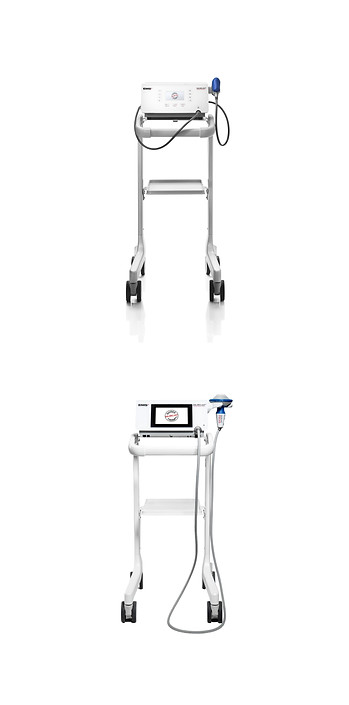
EMS Swiss DolorClast® Radial Shockwave Therapy uses a pneumatic ballistic handpiece.
Compressed air accelerates a projectile inside the handpiece. When that projectile strikes the applicator, its kinetic energy is transferred into an acoustic pressure wave that enters the tissue beneath the treatment head.
The energy spreads outward from the applicator, allowing the clinician to treat accessible tendons, fascia, muscular tissue and connected areas across a clinically relevant treatment field.
It is called extracorporeal treatment because the energy is generated outside the body and transmitted through the skin.
There is:
No incision.
No injection.
No medication entering the tissue.
No significant recovery period away from normal life.
Treatment normally takes only a few minutes, although the clinical appointment includes assessment, reassessment and decisions around movement, loading and rehabilitation.
EMS identifies radial shockwave as part of its Guided DolorClast® Therapy system, which brings device technology, treatment parameters, clinical education and condition-specific protocols together within one framework.

The Machine Is Not the Treatment
Radial shockwave therapy is sometimes presented as though placing the applicator over the painful area is enough.
It is not.
The result depends on a series of decisions:
What tissue are we treating?
Is the diagnosis sufficiently clear?
Can the target be reached effectively?
How irritable is the area?
What energy, frequency and number of impulses are appropriate?
What has already been tried?
What needs to happen between appointments?
These decisions matter because shockwave is dose-dependent. Too little energy may provide an inadequate stimulus. An unnecessarily aggressive dose may create avoidable irritation.
Device performance matters as well. Bench testing has demonstrated that the acoustic output of ballistic pressure-wave systems can change as treatment frequency increases, and different devices do not necessarily maintain equivalent outputs under the same displayed settings.
At Movement Mechanics, pressure, frequency, applicator, treatment area and number of impulses are selected according to the presentation rather than using one standard setting for every patient.
The technology provides the potential.
Clinical judgement determines how that potential is used.


One Biological Objective. Two Ways of Reaching the Tissue.
Radial and focused shockwave are often described online as though one is the basic treatment and the other is an advanced upgrade.
That is not how we view them.
Both EMS DolorClast® systems deliver mechanical energy capable of stimulating biological responses within musculoskeletal tissue. When the target can be reached and an appropriate therapeutic dose delivered, we do not regard radial shockwave as a lesser treatment.
A 2026 systematic review comparing radial and focused shockwave across tendinopathies found no clear overall superiority for pain or physical function. The certainty of much of the evidence was low, which means treatment selection still needs to be guided by anatomy, diagnosis and clinical context rather than a universal hierarchy between devices.
Radial shockwave is delivered through an expanding treatment field. This makes it particularly useful when the relevant tissue is accessible or when the presentation involves a broader region rather than one isolated focal point.
Focused shockwave concentrates energy around a selected depth. It may offer practical advantages where the target is deeper, highly specific, related to bone or contains a discrete calcific deposit. It may also be preferred in selected highly irritable presentations when we want to reach the target while reducing mechanical exposure through the tissue above it.
The decision is not based on which treatment sounds more impressive.
It is based on which delivery method allows us to reach the target safely, comfortably and effectively.
Because Movement Mechanics provides both technologies, the recommendation does not need to be influenced by the limitations of the equipment available.

Plantar heel pain often announces itself during the first few steps in the morning.
It may ease after moving, then return following a longer walk, a day on hard surfaces or an increase in running.
By the time many patients contact us, they have already tried stretching, new shoes, massage, rest or orthotics. The heel may feel temporarily better, but it has not regained enough tolerance for normal activity.
Radial shockwave can be considered as part of a broader plan addressing the plantar fascia, calf capacity, footwear, walking exposure and progressive loading. Research supports ESWT as an established non-invasive option for persistent plantar heel pain, although it is not consistently superior to every other appropriate conservative intervention.

Radial shockwave is most often considered when a reasonably clear tendon, fascia or muscular presentation has become persistent, recurrent or difficult to progress through rehabilitation.
International expert consensus supports considering shockwave for several musculoskeletal indications, including plantar fasciopathy, common extensor tendinopathy, medial elbow tendinopathy, patellar tendinopathy, gluteal tendinopathy and selected Achilles presentations. However, the quality and consistency of evidence varies between conditions.
Why We Use EMS Swiss DolorClast®
Not every radial shockwave system delivers energy in the same way.
Movement Mechanics uses the EMS Swiss DolorClast®, the platform developed by the company that introduced pneumatic ballistic radial shockwave technology in the 1990s.
The significance is not simply the name on the device.
It is the relationship between the engineering, the treatment parameters and the clinical evidence developed using that system.
The EMS platform allows us to adjust the applicator, pressure, frequency and number of impulses according to the tissue and treatment objective. Its acoustic output has also been investigated under different frequency settings, which is important because a protocol cannot be reproduced accurately when the device cannot maintain the intended energy delivery.
Movement Mechanics is a GDT Certified practice and currently offers the complete EMS DolorClast® clinical range:
EMS Swiss DolorClast® Radial Shockwave Therapy
EMS DolorClast® Focused Shockwave Therapy
EMS DolorClast® High-Power Laser Therapy
Movement Mechanics is also currently the only clinic in Aotearoa offering all three EMS modalities within one musculoskeletal practice, and the only clinic using the new EMS DolorClast® Focused Shock Waves device.
That range does not mean every patient receives more treatment.
It means we have fewer reasons to compromise when deciding what treatment is most appropriate.

Biological Optimisation, Not Passive Care.
Everything we do at Movement Mechanics comes back to improving the environment in which tissue is being asked to recover.
We call this Biological Optimisation.
For a tendon or fascia, that may involve more than reducing pain.
It may involve improving local tissue tolerance, addressing an inflammatory or highly reactive presentation, restoring movement through surrounding regions and progressively exposing the tissue to meaningful force again.
Radial shockwave can contribute a controlled mechanical stimulus. Osteopathic care may help address relevant restrictions or improve movement tolerance. Rehabilitation provides the repeated loading required for adaptation. Recovery, sleep, training decisions and general health influence how well the body responds to that plan.
No single treatment performs all of these roles.
The value lies in bringing them together coherently.
This is also why shockwave should not replace rehabilitation. In a randomised trial involving plantar heel pain, radial shockwave combined with tissue-specific stretching produced better outcomes than radial shockwave used alone, reinforcing that the modality works best as part of a wider strategy rather than as an isolated procedure. DolorClast
Movement does not merely test whether recovery has occurred.
Appropriately dosed movement helps shape it.
Movement Matters™

When Mechanical Energy and Light Belong in the Same Plan.
Some persistent conditions are limited by more than one barrier.
The tissue may need a meaningful mechanical stimulus, but pain or irritability may make it difficult to tolerate rehabilitation or comfortably reach the desired shockwave dose.
In selected cases, EMS DolorClast® High-Power Laser Therapy may be integrated alongside radial shockwave.
The modalities do not duplicate one another.
Radial shockwave introduces mechanical energy and engages mechanotransduction.
High-power laser introduces light energy associated with photobiomodulation, which may influence cellular metabolism, inflammatory signalling and pain modulation.
Laser may be used to improve comfort, reduce tissue reactivity or create a better window for movement. Shockwave may then provide the mechanical input considered appropriate for the target tissue.
This does not mean using two treatments is automatically better than using one.
There is no universal combined protocol proven to be superior for every tendon or musculoskeletal presentation. At Movement Mechanics, combination care is recommended only when each modality has a clear and separate role within the plan.
Some patients need radial shockwave alone.
Some require focused shockwave.
Some benefit from laser therapy without shockwave.
Others need rehabilitation, osteopathic care or further investigation rather than any device.
The advantage of offering the full EMS range is not the opportunity to add more treatment. It is the ability to choose more carefully.

You Do Not Need to Choose the Device Before You Book
Most patients should not be expected to diagnose their own condition or decide which technology they require.
That is our responsibility.
Your first appointment begins with a conversation about how the problem started, what has already been tried and what it is currently preventing you from doing. If unsure, book a Focused Shockwave Therapy + Laser consultation; this will give you the longest appointment and with a practitioner who offers all three modalities.
We then assess the likely tissue involved, relevant movement, strength, irritability and loading tolerance. We review imaging where it is available and clinically relevant.
From there, we determine whether:
-
Radial shockwave can reach the target and deliver the required stimulus.
-
Focused shockwave offers a practical advantage.
-
High-power laser therapy has a role.
-
Rehabilitation needs to be modified or progressed.
-
Further imaging or referral is appropriate.
Where shockwave is indicated and safe, treatment can usually begin during the same appointment. Booking an assessment does not commit you to a treatment package.
Sometimes radial shockwave is precisely what is required. Sometimes the most valuable outcome is being told that it is not.
Evidence-based care begins with making the right decision, not the most expensive one.

What Does Radial Shockwave Treatment Feel Like?
Treatment creates a rapid tapping or pulsing sensation beneath the applicator.
Some areas feel relatively comfortable. Others may feel tender, especially when the handpiece moves across the tissue, reproducing the familiar symptoms.
The intensity is introduced progressively and adjusted according to the diagnosis, tissue irritability, treatment objective and your tolerance.
Treatment should not become a test of how much discomfort you can endure.
More pain does not automatically equal a better dose.
The active shockwave portion of the appointment generally takes only a few minutes. Mild short-term soreness, redness or bruising can occur afterwards. Most people can continue ordinary daily activity, although temporary modifications may be recommended according to the area treated and the demands of their sport or occupation.
Shockwave is commonly delivered as a short series of appointments rather than indefinite weekly care. The number and interval are determined by the condition, response and research-informed protocol rather than selling a fixed course before assessment.
International consensus supports the use of condition-specific parameters and appropriate screening, while recognising that significant variation remains within shockwave protocols across research and clinical practice.


Who Is Most Likely to Benefit From an Assessment?
Radial shockwave therapy may be worth discussing when:
-
Your symptoms repeatedly return as activity increases.
-
You have completed a genuine course of rehabilitation without achieving the expected progress.
-
Pain is preventing you from loading the tissue strongly enough to rebuild capacity.
-
You have received repeated passive treatment without a clear pathway back to work, exercise or sport.
-
You have been offered an injection and want to understand appropriate non-invasive options first.
-
The diagnosis appears consistent with an established shockwave indication.
-
You are prepared to take an active role in the rehabilitation that accompanies treatment.
It may be less appropriate where the diagnosis is unclear, symptoms suggest an acute rupture or serious pathology, or the treatment area includes structures that cannot be safely exposed.
An assessment is designed to establish that distinction.
When Shockwave Therapy Is Not Appropriate
Shockwave therapy requires appropriate screening.
Treatment may need to be avoided, postponed or medically cleared where there is:
-
a suspected acute rupture or high-grade tendon tear
-
active infection within the treatment area
-
a malignant or suspicious lesion at the intended site
-
pregnancy involving the treatment region
-
significant bleeding or coagulation concerns
-
vulnerable neurological, pulmonary or vascular structures within the treatment field
-
recent surgery, injection or medication considerations requiring further review
Anticoagulant medication, corticosteroid injections, altered sensation and relevant medical conditions should be discussed before treatment.
International expert recommendations include both absolute and relative contraindications and emphasise that safety depends on the treatment region, tissue target and clinical circumstances.
Shockwave should never be used to delay investigation of a suspected rupture, fracture, infection or other condition requiring medical management.

Radial Shockwave Therapy in Browns Bay
Movement Mechanics is based inside Bays Health on Bute Road in Browns Bay.
We work with patients from across Auckland’s North Shore, including Torbay, Long Bay, Albany, Mairangi Bay, Milford and Takapuna, as well as people travelling from wider Auckland specifically for EMS DolorClast® treatment.
Our clinical approach brings together:
Osteopathic assessment and hands-on care.
EMS radial and focused shockwave therapy.
EMS high-power laser therapy.
Medical acupuncture.
Movement and rehabilitation guidance.
Movement Mechanics was founded on the belief that patients should have access to modern, evidence-informed and non-invasive options before accepting that persistent pain must simply be lived with, repeatedly injected or automatically progressed towards surgery.
Conservative care cannot remove the need for every procedure.
It can, however, provide a meaningful pathway for many musculoskeletal conditions where the diagnosis, evidence and individual circumstances support it.

Clinical Experience Behind the Technology
Radial shockwave treatment is led by Jonathan Hall, founder and Clinical Director of Movement Mechanics.
Jonathan is an ACC-registered osteopath with more than a decade of clinical experience. He is New Zealand’s EMS DolorClast® Key Opinion Leader and has specific clinical expertise across radial shockwave, focused shockwave and high-power laser therapy.
His approach combines osteopathic assessment, tissue-specific treatment and rehabilitation within the Movement Mechanics philosophy of Biological Optimisation.
The objective is not simply to deliver a machine-based procedure.
It is to understand what is limiting recovery, choose the right intervention and help restore the movement that pain has gradually taken away.

When Progress Has Stopped, More of the Same May Not Be Enough
Persistent heel, tendon or musculoskeletal pain can gradually narrow your life.
You stop walking as far.
You hesitate before running.
You modify how you lift.
You avoid the activities that repeatedly make the problem return.
Radial shockwave therapy may help change that trajectory, but only when it is applied to the right tissue, for the right reason and supported by a plan that rebuilds capacity.
At Movement Mechanics, the device does not decide the treatment. The assessment does. Because the goal is not simply to treat a painful structure. It is to help you move confidently again.
Movement Mechanics. Movement Matters™.
Ready to find out whether radial shockwave is appropriate?
Book an assessment at our Browns Bay clinic. We will determine whether radial shockwave, focused shockwave, high-power laser therapy, osteopathy, rehabilitation or another pathway is most appropriate for your presentation.
