

Focused Shockwave Therapy Auckland
At Movement Mechanics Osteopathy, we became the first clinic in Aotearoa New Zealand to invest in the EMS DolorClast® Focused Shockwave system because we believed our patients deserved access to technology capable of treating conditions beyond the reach of conventional therapies.
Our philosophy has never been to own the newest technology for the sake of innovation.
We invest in technologies where there is a sound biological rationale, growing clinical evidence and a meaningful opportunity to improve patient outcomes.
Focused shockwave therapy represents one of those investments.
Movement Mechanics offers the complete EMS Guided DolorClast® Therapy range:
-
EMS DolorClast® Focused Shock Waves.
-
EMS Swiss DolorClast® Radial Shock Waves.
-
EMS DolorClast® High-Power Laser.
-
Osteopathic assessment, hands-on care and rehabilitation guidance.
Because no single technology is appropriate for every problem, we assess the condition before recommending focused shockwave, radial shockwave, laser therapy, hands-on treatment, rehabilitation or an appropriate combination.
Book a focused shockwave consultation →
*No referral is required. If you are unsure which service to choose, book an initial osteopathic consultation with Jonathan Hall, and we will assess the most appropriate pathway.

Not Better. More Precise.
One of the questions we are asked most frequently is:
"Is focused shockwave better than radial shockwave?"
The answer is more nuanced.
Neither technology is universally superior.
Both have strong evidence supporting their use across a wide range of musculoskeletal conditions.
The key difference lies in how the energy is delivered, which tissues are being targeted, and the biological objective of treatment.
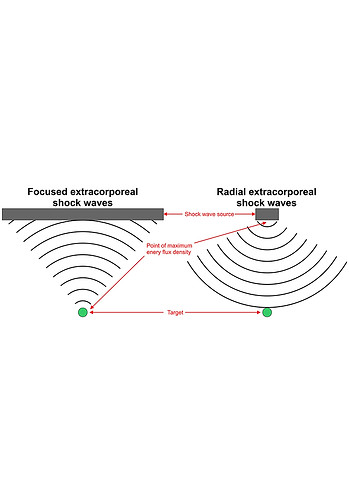
Radial shockwave disperses mechanical energy over a broader treatment area, making it an excellent option for many superficial tendons, fascia and myofascial structures.
Focused shockwave concentrates energy within a precisely selected focal point beneath the skin, allowing deeper anatomical structures to be treated with considerably greater accuracy while minimising unnecessary energy delivery to surrounding tissues.
Rather than replacing radial shockwave, focused shockwave expands what is possible.
At Movement Mechanics, we choose the technology based on your diagnosis, not the other way around.
Movement Mechanics is currently the only clinic in Aotearoa using the new EMS DolorClast® Focused Shock Waves device.*


What Is Focused Shockwave Therapy?
Focused shockwave therapy is a non-invasive clinical modality that applies acoustic shockwaves from outside the body toward a defined treatment area.
The waves converge within a focused treatment zone rather than dispersing broadly from the applicator. This allows the clinician to select a specific treatment depth and concentrate the acoustic energy around the intended tissue.
Focused shockwave therapy is not:
-
An electrical shock.
-
Diagnostic ultrasound.
-
Therapeutic ultrasound.
-
A surgical procedure.
-
An injection.
-
The same technology as radial pressure-wave therapy.
It is one form of extracorporeal shockwave therapy, commonly abbreviated to ESWT or fESWT.
Research has investigated ESWT for a range of musculoskeletal presentations, including persistent plantar heel pain, calcific shoulder tendinopathy, greater trochanteric pain syndrome and knee osteoarthritis. Whether it is appropriate depends on the diagnosis, individual health history, treatment area and clinical findings.

Why Precision Matters
Musculoskeletal conditions are rarely identical.
Two patients may both present with shoulder pain, yet one has superficial supraspinatus tendinopathy while the other has a deep calcific deposit embedded within the tendon.
Both require shockwave therapy.
They do not necessarily require the same shockwave.
Focused shockwave allows treatment to be directed toward a specific pathological structure rather than simply the painful region.
This precision becomes particularly valuable when treating deeper tendons, entheses, subchondral bone, delayed union fractures or conditions where evidence suggests focused shockwave may provide distinct advantages.
For the patient, this means treatment is guided by anatomy, pathology and clinical reasoning, not by equipment limitations.
The Science Behind Focused Shockwave Therapy
The Science Behind Focused Shockwave Therapy
EMS DolorClast® Focused Shockwave Therapy delivers high-energy acoustic waves using piezoelectric technology.
When these mechanical waves interact with living tissue, they initiate a process known as mechanotransduction, the conversion of mechanical stimulation into biological activity.
Rather than masking symptoms, this mechanical stimulus encourages cells to respond.
Research has demonstrated that extracorporeal shockwave therapy can influence a range of biological processes relevant to musculoskeletal healing, including:
-
increased angiogenesis and microvascular remodelling
-
stimulation of tenocyte activity
-
collagen synthesis and extracellular matrix remodelling
-
modulation of neurogenic inflammation
-
reduction in Substance P and CGRP
-
promotion of bone remodelling
-
improved tendon-to-bone interface healing in experimental models
-
stimulation of local growth factor expression including VEGF and eNOS
These effects continue well beyond the treatment session itself, reflecting biological adaptation rather than temporary symptom suppression.


High-quality evidence consistently supports focused shockwave therapy as one of the leading non-surgical treatment options for symptomatic calcific tendinopathy.

While focused shockwave is not required for every condition, contemporary evidence suggests it may be particularly valuable in presentations involving deeper tissues or where precise energy delivery is desirable.
Examples include:
One Clinic. Three Technologies.
One of the greatest advantages for our patients is not that we own focused shockwave.
It is that we are not limited to focused shockwave.
Movement Mechanics is currently the only clinic in Aotearoa offering:
-
EMS DolorClast® Radial Shockwave Therapy
-
EMS DolorClast® Focused Shockwave Therapy
-
EMS DolorClast® High-Power Laser Therapy
This allows treatment plans to be built around the biology of the condition rather than the capabilities of a single device.
Some patients require radial shockwave alone.
Some benefit from focused shockwave.
Others achieve the greatest benefit from combining focused shockwave with high-power laser therapy to address both mechanical and biological aspects of tissue recovery.
Our role is to determine which approach is most appropriate, not to fit every patient into the same protocol.

Our Clinical Philosophy.
Technology should never replace clinical reasoning.
It should enhance it.
Every patient undergoes a comprehensive osteopathic assessment before treatment recommendations are made.
We consider:
-
your diagnosis
-
the stage of tissue healing
-
imaging findings where available
-
previous treatments
-
activity demands
-
surgical history
-
rehabilitation goals
Only then do we decide whether focused shockwave therapy forms part of the most appropriate management plan.
Sometimes it does.
Sometimes radial shockwave is the better option.
Sometimes neither is indicated.
Evidence-based care begins with making the correct decision, not the most expensive one.

Focused shockwave therapy is still relatively new in New Zealand, so it naturally raises questions about how it differs from conventional shockwave treatment, which conditions it is best suited to and whether it may be appropriate for your injury. Below are answers to some of the questions we are asked most frequently.
Precision Matters. So Does Clinical Judgement.
Focused shockwave therapy is an exciting advancement in musculoskeletal medicine, but it is only one part of effective care.
Our objective is never simply to deliver a treatment.
It is to understand the biology of your condition, identify the factors limiting recovery and develop an evidence-based plan that gives you the greatest opportunity to return to the activities that matter most.
Because at Movement Mechanics, movement matters, and every treatment decision begins with helping you move better, heal better and stay active for longer.
