

Shockwave Therapy North Shore
Browns Bay Clinic
EVIDENCE-BASED SHOCKWAVE THERAPY THAT WORKS AUCKLAND
EMS DolorClast® radial & focused shockwave, minutes from Albany, Takapuna and the East Coast Bays
Looking for shockwave therapy close to home? Movement Mechanics is based inside Bays Health at 13–15 Bute Road, Browns Bay, an easy drive from Albany, Takapuna, Milford, Mairangi Bay, and Long Bay, with free parking within Bays Health.
We're the North Shore's EMS DolorClast® certified clinic, and the only clinic in New Zealand offering both radial and focused shockwave, so whether your problem is superficial (plantar fasciitis, tennis elbow, achilles tendinopathy) or deep (hip, hamstring, shoulder), it can be treated properly here rather than referred elsewhere.
Appointments are available the same week, Monday to Saturday, including evenings until 7 pm; no GP referral needed. We're ACC registered and Southern Cross Easy-claim, and your first visit is an assessment so we can confirm shockwave is right for your condition before treatment starts.
Want the full detail on how shockwave works, the evidence and what to expect? See our main shockwave therapy page or read about focused shockwave therapy.
Book an Assessment → or call Ava on 09 884 0935.
Shockwave therapy in Auckland – what it is and why it works
Shockwave therapy (extracorporeal shockwave therapy, ESWT) uses targeted acoustic pulses to stimulate healing in injured or overloaded tissues. It is widely used in musculoskeletal medicine to treat chronic and sub-acute pain by:
-
stimulating tissue repair and remodelling
-
improving blood flow and metabolism
-
reducing pain and inflammation
-
releasing stubborn trigger points
-
increasing tissue lubrication (lubricin production)
Not all shockwave therapy is equal. The device used and the way energy is delivered are critical to whether treatment actually works. That’s why we use EMS DolorClast® technology, one of the most researched shockwave systems worldwide. We provide shockwave therapy across Browns Bay, the North Shore, and greater Auckland.

Benefits of EMS DolorClast® shockwave therapy
EMS DolorClast® shockwave therapy is a modern, non-surgical treatment designed for conditions that are slow to heal or repeatedly flare.

Reduced pain and inflammation
Shockwave therapy helps modulate pain signals and reduce inflammation at the tissue level, often leading to meaningful pain reduction early in treatment.

Unmatched performance
Not all shockwaves are equal. Compared to competitor devices, EMS DolorClast® has no drop off in power as we increase frequencies

Improved movement and function
As pain reduces and tissue quality improves, patients often notice better strength, flexibility and confidence in movement.
Shockwave therapy backed by research
EMS DolorClast® devices have been used in more high-quality studies listed in the PEDro physiotherapy evidence database than any other shockwave system. This makes them a benchmark device for clinicians who want shockwave therapy that works, not just a label. This matters because shockwave therapy is dose-dependent; the biological response depends on delivering sufficient and consistent energy to tissue.

Shockwave therapy delivers controlled acoustic energy into injured tissue, triggering a cascade of beneficial effects including:
-
pain modulation
-
stimulation of new blood vessel growth
-
improved tissue lubrication
-
reduction in chronic inflammation
-
activation of repair pathways
Some patients notice improvement after the first session, but most conditions respond best over 4–6 sessions, spaced weekly or fortnightly depending on the condition.
Shockwave therapy is commonly used as a non-invasive alternative to steroid injections or surgery, particularly for chronic tendon and soft-tissue pain.
Why the shockwave therapy device matters
Shockwave therapy is not interchangeable between devices.
Many systems lose effective energy output at higher frequencies, meaning the treatment delivered to tissue may be far less than expected. This can limit results, especially for deeper or chronic conditions.
At Movement Mechanics, we use EMS DolorClast® radial and focused shockwave therapy because:
-
they maintain consistent energy delivery
-
they are supported by independent research
-
they allow accurate dosing for different tissues and depths
This ensures you receive effective shockwave therapy, not just a sensation.


No referral is needed to access our services. Simply book an initial osteopathic consultation, and our qualified osteopaths will assess if shockwave therapy is suitable for your condition. For existing patients, you can ask your osteopath whether shockwave therapy can be incorporated into your treatment for enhanced recovery or pain management.
Conditions commonly treated with shockwave therapy
Our shockwave therapy North Shore service is used for a wide range of musculoskeletal conditions, including: Plantar fascia treatment, heel pain treatment, Achilles tendinopathy treatment, tennis elbow treatment, hip pain treatment, shoulder bursitis treatment, knee osteoarthritis, patellar tendinopathy, gluteal tendinopathy, chronic trigger points
Both radial and focused shockwave therapy are used depending on tissue depth and condition.
Plantar fasciitis (plantar fasciopathy) is the leading cause of heel pain and accounts for a significant proportion of foot complaints.
Shockwave therapy has been shown to:
-
significantly reduce heel pain
-
improve function and walking tolerance
-
outperform some traditional treatments when combined with guided stretching
It is particularly effective for chronic cases that have not resolved with rest or basic rehabilitation.


Knee osteoarthritis can be a painful and disruptive condition. Shockwave Therapy is a non-invasive, fast, effective and safe approach to treatment for knee osteoarthritis symptoms. It can provide pain relief through pain modulation and improve the movement of the knee through the stimulation of lubricin production. It is also great at helping with inflammation that has developed due to the changes in how the knee is moving.
Patellar tendinopathy
Patellar tendinopathy, often called jumper’s knee, is a chronic overuse injury of the patellar tendon. The condition can be debilitating and may prevent patients from returning to sports for long periods. Shockwave therapy is a safe and effective treatment option for chronic patellar tendinopathies that have not responded to conservative treatment such as physiotherapy or chiropractors. The best results are obtained when shockwave therapy is combined with eccentric exercises and osteopathic treatment.


Shoulder pain and bursitis treatment
Shoulder pain may arise from rotator cuff tendinopathy, bursitis, calcific tendinitis or impingement.
Shockwave therapy is particularly effective for calcific shoulder tendinopathy, with studies showing reductions in pain, improvements in function and resorption of calcium deposits in a high percentage of patients.
Achilles tendinopathy affects the tendon connecting the calf muscles to the heel and can become persistent and limiting.
Research shows that low-energy shockwave therapy combined with loading exercises is an effective treatment for chronic Achilles tendinopathy, improving pain and function over time.
Shockwave therapy helps stimulate tendon remodelling while reducing pain, allowing rehabilitation to progress safely.

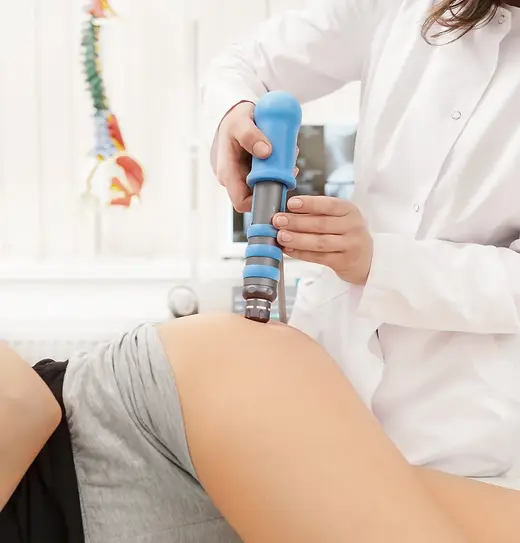
Lateral hip pain often involves gluteal tendinopathy or trochanteric bursitis.
Research shows that radial shockwave therapy can outperform corticosteroid injections and home exercise alone, with faster return to activity and sustained improvements. At four months post-treatment, 64% of patients can return to sports due to radial shockwave therapy.
Questions about how shockwave works, session numbers, side effects, ACC or Southern Cross? See our full FAQs